+86 17326062766
Leave Your Message
-
Contact WhatsApp
-
 Contact Phone
-
 Contact Email
Picking the right solar battery bank manufacturer or supplier in China isn’t just about hunting for the lowest price. You want a partner who truly understands solar energy systems, knows the ins and outs of storage safety, and considers real-world installation conditions. It’s about more than just specs and costs.
A solar battery bank stores the power generated during the day so you can use it in the evening, during cloudy days, or as backup if the grid goes down. But its performance hinges on a few key things—like the quality of the cells, the battery management software, how well it manages heat, and making sure you get the right size for your needs. Reliable manufacturers should be upfront about things like cycle life, usable capacity, warranty details, and test reports. Plus, they should be aware of regional standards—things like IEC, UN 38.3, or UL—that your system needs to meet, especially if the batteries are tucked away in a garage, workshop, or a remote solar cabinet.
Dr. Imre Gyuk, a well-known expert in energy storage, once said that storage is “a key enabling technology for renewable energy.” And honestly, he’s got a point. Solar panels only produce power when the sun’s shining, so batteries come in and make that energy usable when you need it most.
Of course, no battery is perfect. And a responsible supplier won’t pretend they are. They’ll be upfront about the limitations—like how high temperatures can cut into the battery’s lifespan or how poor ventilation might pose safety risks. Sometimes, choosing a system that's too big can waste your money, while going too small might leave you in the lurch during longer outages. That’s why good manufacturers take a close look at your load patterns, climate, how you charge the batteries, and any future expansion plans before recommending what’s best.
And here’s a little truth that some folks overlook: just knowing the specs doesn’t guarantee the system will perform well in the field. Installation quality really matters, and how you use the system is just as crucial. So, when shopping around, it’s smart to check how much experience the factory has, their quality control processes, after-sales support, and if they can provide traceable documentation. A trustworthy solar battery bank maker earns your confidence by showing real evidence, keeping consistent communication, and offering solutions that match real-world daily use—because at the end of the day, it’s all about reliable, safe, and efficient energy storage that actually works for you.
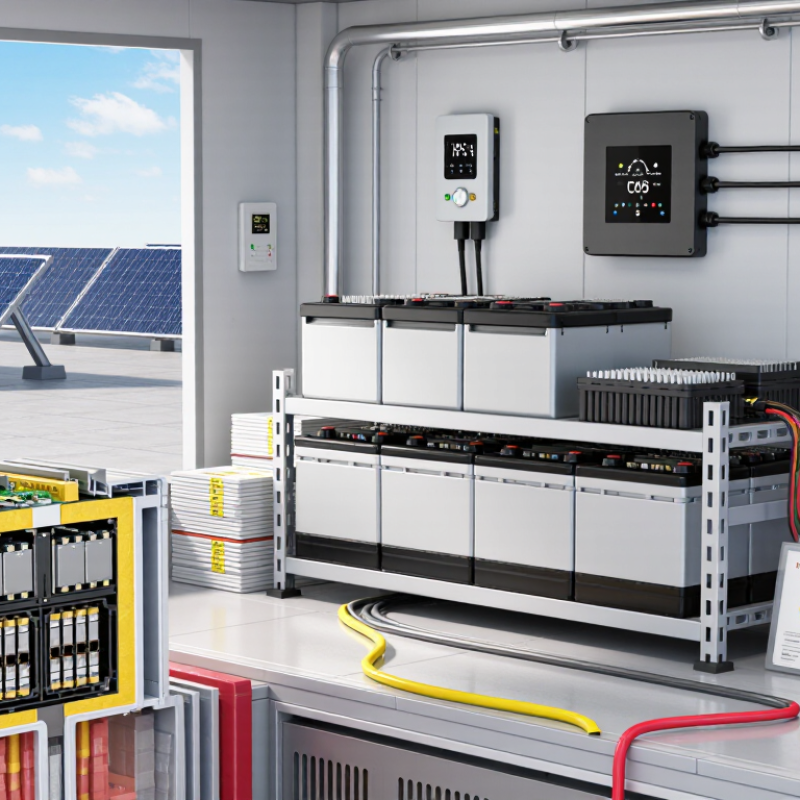
China Best Solar Battery Bank Manufacturer Supplier
Definition and Role of a Solar Battery Bank Manufacturer
A solar battery bank manufacturer designs and produces batteries that store electricity from photovoltaic systems. The bank supplies power when sunlight is weak, unavailable, or interrupted. A dependable manufacturer does more than assemble battery cells. It selects suitable chemistry, builds the battery management system, and verifies safe operation under changing loads.
In practical projects, engineers examine daily energy use, solar capacity, temperature, and backup requirements before recommending storage. A rural cabin may need a compact 5 kWh bank, while a workshop can require several cabinets. The manufacturer should provide clear capacity data, cycle-life test conditions, charging limits, and installation guidance. Numbers without test conditions can mislead buyers.
Quality control happens at several points. Technicians inspect cell consistency, weld strength, insulation, communication ports, and thermal performance. Protection against overcharge, deep discharge, short circuits, and excessive heat is essential. Factory records should connect each unit with inspection results and shipment details. This supports traceability and more reliable after-sales service.
A supplier also helps integrators match the battery with inverters and energy management systems. Real field conditions are rarely perfect. Dust, cold mornings, irregular loads, and user mistakes can reduce performance. No battery is perfect. Manufacturers should explain these limits honestly, instead of promising unrealistic savings. A careful supplier may revise its design after installation feedback, because small wiring or ventilation problems often reveal more than laboratory figures.
| Category | Data Dimension | Typical Data or Industry Information | Manufacturer's Role |
|---|---|---|---|
| Product Definition | Solar Battery Bank | A group of rechargeable batteries connected in series, parallel, or a combination of both to store electricity generated by a solar photovoltaic system. | Designs the battery bank according to the required voltage, capacity, load profile, and installation environment. |
| Energy Storage | Common System Capacity | Residential systems commonly range from approximately 5 kWh to 30 kWh, while commercial and industrial systems may be configured from tens of kilowatt-hours to multiple megawatt-hours. | Provides modular battery configurations that can be expanded as energy demand increases. |
| Battery Chemistry | Lithium Iron Phosphate (LFP) | LFP batteries are widely used in stationary solar storage because of their good thermal stability, long cycle life, and absence of cobalt in the cathode material. | Selects suitable cells, integrates protection systems, and verifies the battery pack's operating limits. |
| Battery Chemistry | Lead-Acid Batteries | Flooded, gel, and absorbed glass mat batteries are established storage technologies. They generally require more space and have lower usable depth of discharge than many lithium-based systems. | Matches the battery type with budget, maintenance requirements, ambient conditions, and expected operating frequency. |
| Electrical Performance | Nominal Voltage | Common battery-bank configurations include 12 V, 24 V, and 48 V for smaller off-grid systems. Higher-voltage battery systems are also used in larger energy-storage installations. | Configures cell and module connections to meet the inverter and system-voltage requirements. |
| Electrical Performance | Usable Capacity | Usable capacity is the energy available within the permitted state-of-charge window. It is lower than the nameplate capacity when reserve capacity and operating limits are included. | States rated and usable capacity clearly and provides appropriate battery-management settings. |
| Operating Life | Cycle Life | Cycle life depends on chemistry, depth of discharge, temperature, charging rate, and maintenance. LFP systems are commonly specified for several thousand cycles under defined test conditions. | Publishes test conditions and warranty assumptions instead of presenting cycle-life figures without operating parameters. |
| System Efficiency | Round-Trip Efficiency | Battery round-trip efficiency represents the percentage of electrical energy recovered after a complete charge and discharge cycle. Actual system efficiency also includes inverter and wiring losses. | Optimizes cell matching, power electronics integration, thermal management, and standby consumption. |
| Protection | Battery Management System | A BMS monitors voltage, current, temperature, state of charge, and fault conditions. It can provide overcharge, over-discharge, overcurrent, and short-circuit protection. | Integrates hardware and software safeguards and supports communication with compatible inverters. |
| Safety | Thermal Management | Battery systems may use natural convection, forced-air cooling, or liquid cooling depending on capacity, power density, enclosure design, and installation conditions. | Evaluates heat generation, ventilation, temperature limits, and emergency protection during system design. |
| Installation | Indoor and Outdoor Enclosures | Outdoor battery cabinets require protection against dust, moisture, corrosion, and accidental contact. The required enclosure rating depends on the site and applicable installation rules. | Offers suitable cabinets, mounting structures, cable glands, disconnects, and environmental protection. |
| Solar Integration | AC-Coupled and DC-Coupled Systems | DC-coupled systems connect the battery on the photovoltaic side of the inverter, while AC-coupled systems connect through an additional battery inverter on the AC side. | Recommends the appropriate architecture based on new installation, retrofit requirements, conversion efficiency, and control strategy. |
| Application | Common Use Cases | Applications include solar self-consumption, backup power, off-grid electrification, peak-load management, time-of-use energy shifting, and microgrid operation. | Adapts power rating, energy capacity, controls, and communication functions to the intended application. |
| Sizing | Load and Autonomy Calculation | Battery sizing considers daily energy consumption, critical loads, desired backup duration, battery efficiency, allowable depth of discharge, solar production, and future demand. | Uses site data and load studies to prevent both undersizing and unnecessary oversizing. |
| Quality Control | Cell Matching and Testing | Important production checks include cell voltage consistency, capacity testing, insulation testing, communication verification, charging and discharging tests, and final inspection. | Maintains traceability from cells to finished modules and documents production and performance tests. |
| Compliance | Safety and Transport Requirements | Depending on the market and product type, stationary batteries may need to address applicable electrical, fire, EMC, transport, and battery-safety requirements. | Supports required certification, technical documentation, labeling, shipping classification, and installation guidance. |
| Service | Technical Support | Useful support typically includes installation manuals, wiring diagrams, inverter compatibility information, commissioning procedures, troubleshooting guidance, and maintenance instructions. | Provides engineering assistance before delivery and after commissioning throughout the product service period. |
| Procurement | Manufacturer Selection Criteria | Key factors include verified specifications, product traceability, quality-control procedures, safety documentation, warranty terms, communication compatibility, delivery capability, and technical support. | Demonstrates manufacturing capability and supplies transparent, application-specific technical information. |
As energy storage expands across renewable power, commercial facilities, and industrial applications, industry research increasingly emphasizes safety, efficiency, scalability, and transparent battery data. High-performance passive balancing BMS technology supports these priorities by helping maintain cell consistency while reducing system complexity and cost. A reliable slave monitoring unit can observe battery conditions in real time during charging and discharging, giving operators timely insight into system performance and potential risks.
The SBMU series is designed as a practical component within a complete battery management architecture. It accurately measures individual cell voltage and battery temperature, while supporting protection against under-voltage, over-voltage, under-temperature, and over-temperature conditions. Integrated alarm functions help identify abnormal conditions at an early stage, while seamless CAN communication transfers essential data to the master controller for coordinated monitoring and control. Manufactured in China, these passive balancing units are suitable for diverse energy storage configurations and can help improve operational stability, battery safety, and service efficiency. Their compact, dependable design makes them a strong choice for system integrators seeking a scalable BMS solution tailored to modern energy storage demands.
Homes often use wall-mounted or stackable lithium iron phosphate batteries. Commercial sites may use rack-mounted cabinets. Utility projects often use containerized systems. Hybrid inverters can connect batteries, solar panels, and backup circuits.
It offers strong thermal stability and a long cycle life. It suits many residential and commercial storage systems. Still, no chemistry fits every site. Climate and maintenance access can change the decision.
Nickel-manganese-cobalt cells provide higher energy density. They require stricter thermal management. This may help where installation space is limited. The extra control requirements should not be underestimated.
Sodium-ion batteries are entering the market. Their commercial experience remains limited. Buyers should request recent performance records and operating data. Early adoption can involve uncertainty.
Check usable energy, round-trip efficiency, depth of discharge, warranty coverage, and operating temperature. Request cell traceability and factory test records. Independent performance data is useful. A low price may hide weak software support.
Yes. Custom options may include voltage, usable capacity, cabinet size, communication protocols, and monitoring functions. Engineers should review load profiles, sunlight, space, and safety needs. Bigger is not always better.
The system should pass cell-matching, insulation, temperature, and discharge tests. Test results should be documented before delivery. Cable length and ventilation also matter. Small installation details can cause large problems.
A quotation should show usable capacity, equipment costs, delivery terms, payment timing, and spare-part prices. Warranty documents should state coverage limits and end-of-warranty capacity. Ask who handles valid return freight. A polished brochure is not enough.
China has become an important source of solar energy storage equipment, offering a wide range of solutions for residential, commercial, and industrial use. A Solar Battery Bank manufacturer typically designs and produces battery systems that store electricity generated by solar panels for use during nighttime, cloudy weather, or power interruptions. Common technologies include lithium iron phosphate and other lithium-based batteries, with differences in safety, lifespan, energy density, and cost. When evaluating a supplier, buyers should review production capacity, technical expertise, quality management, certifications, testing procedures, and project experience.
Reliable suppliers may provide customized battery capacity, voltage, communication interfaces, cabinet designs, and system configurations to match specific installation requirements. Buyers should also compare pricing, warranty terms, delivery schedules, packaging, installation guidance, and after-sales service. The best choice depends on energy demand, available space, climate, backup requirements, budget, and compatibility with inverters or energy management systems. Careful evaluation helps customers obtain a safe, durable, efficient, and cost-effective solar storage solution.