+86 17326062766
Leave Your Message
-
Contact WhatsApp
-
 Contact Phone
-
 Contact Email
Advanced control and power conversion architectures for modern C&I microgrids.

System-level display and control unit designed for multi-megawatt C&I hybrid power inverter clusters and battery storage systems.
Learn More
Passive balancing slave unit optimized for integrating high-voltage battery banks with utility-scale hybrid storage inverters.
Learn More
Features MCU S32K312/NXP, 120MHz, 2M Flash, ASIL B. Engineered for extreme reliability in demanding industrial environments.
Learn More
Supports 1500V total voltage and insulation resistance monitoring for high-power commercial hybrid energy storage systems.
Learn MoreAn In-Depth Analysis of Hybrid Power Inverters in C&I Settings
Commercial and industrial (C&I) facilities are facing unprecedented challenges in today's energy landscape. Rapidly fluctuating grid tariffs, peak demand charges, strict carbon compliance mandates, and the constant threat of power disruptions are forcing enterprises to rethink their power strategies. Traditional grid-tied solar systems, while beneficial, are no longer sufficient because they lack the flexibility to manage peak loads dynamically or provide backup during grid outages. This is where the hybrid power inverter for commercial and industrial facilities becomes the cornerstone of modern microgrids.
A C&I hybrid power inverter acts as the central brain of a facility's energy ecosystem. Unlike standard grid-tied or off-grid inverters, a hybrid inverter manages multiple power sources simultaneously: the utility grid, on-site solar PV arrays, battery energy storage systems (BESS), and auxiliary backup generators. By intelligently routing power based on real-time demands, tariff structures, and grid conditions, these systems optimize energy usage, lower operational expenses (OpEx), and guarantee business continuity.
Did You Know? For many industrial plants, peak demand charges can account for up to 30% to 50% of the total monthly electricity bill. A commercial hybrid power inverter mitigates this through automated peak shaving, drawing stored battery power when grid rates are at their highest.
The integration of hybrid inverters in C&I facilities is driven by several key factors:
When deploying a hybrid power inverter for commercial and industrial facilities, engineers must choose between DC-coupled and AC-coupled system topologies. The choice depends on whether the installation is a new greenfield project or a retrofit of an existing solar array.
DC-Coupled Systems: In a DC-coupled configuration, both the solar PV array and the battery storage system connect to the same DC bus inside the hybrid inverter. This architecture is highly efficient for new installations, as the solar energy is converted directly to DC to charge the batteries, minimizing round-trip conversion losses. It simplifies control systems and reduces hardware footprint.
AC-Coupled Systems: For facilities with existing grid-tied solar systems, AC coupling is often preferred. The existing solar inverter remains in place, and a hybrid bi-directional storage inverter is added to the AC bus. This allows the battery system to charge from either the grid or the excess AC power generated by the solar system. While it introduces slightly more conversion losses, it offers unparalleled flexibility and modularity for system expansions.
Tailored energy architectures for complex C&I environments.

Deploys hybrid power inverters to create independent energy grids for remote industrial sites, mining operations, and island resorts.
Explore Microgrids
Combining PV arrays, battery storage, and EV charging stations managed by high-capacity hybrid inverter technology.
Explore EV Charging
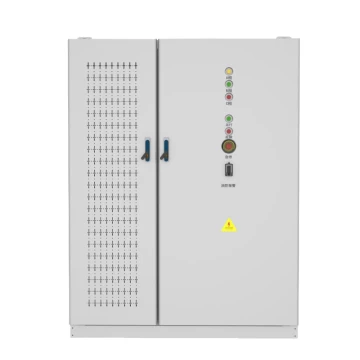
Turnkey industrial energy storage cabinet solutions designed for high-capacity backup power and local load balancing.
Explore Cabinet SystemsThe rapid pace of technological innovation is continuously expanding the capabilities of commercial hybrid power systems. Several notable trends are shaping the future of this sector:
To reduce system costs and increase efficiency, utility-scale and large C&I projects are shifting from 1000V DC inputs to 1500V DC inputs. A 1500V system allows for longer string lengths, fewer combiner boxes, and thinner cables, reducing installation labor and materials. This shift requires highly specialized, automotive-grade master controllers and BMS solutions to monitor high-voltage insulation and battery health accurately.
Modern hybrid inverters are no longer passive converters; they are active computing nodes. Integrated with AI algorithms, the EMS can analyze historical load patterns, weather forecasts, and spot market electricity prices. By doing so, the system dynamically schedules charging and discharging cycles to maximize financial returns. For example, if a storm is forecasted, the system will prioritize charging the batteries to 100% capacity to guarantee backup power.
Standard solar inverters are "grid-following," meaning they require an active grid signal to operate. In contrast, advanced C&I hybrid inverters feature grid-forming capabilities. They can establish a local voltage and frequency reference, allowing the facility to run entirely off-grid for extended periods. This is critical for microgrids operating in areas with unstable utility grids.
As power densities increase, thermal management becomes critical. Liquid cooling and immersion cooling are replacing forced-air cooling in high-power hybrid inverter configurations and battery storage cabinets. These systems maintain uniform temperatures across components, extending system lifespan, preventing thermal runaway, and allowing systems to operate at full capacity even in extreme climates.
Investing in a hybrid power inverter for commercial and industrial facilities is not just an engineering decision; it is a strategic financial move. By analyzing the Levelized Cost of Storage (LCOS) and combining it with peak shaving savings, businesses typically see a full return on investment (ROI) within 4 to 7 years, depending on local utility tariffs and incentives.
Furthermore, as corporations face increasing pressure to meet Environmental, Social, and Governance (ESG) criteria, hybrid inverters provide verifiable data on carbon offset and green energy utilization. By maximizing the use of on-site clean energy and reducing reliance on fossil-fuel-based grid power, businesses can significantly lower their Scope 1 and Scope 2 emissions, strengthening their market position and appealing to environmentally conscious investors.
Established in 2011 and headquartered in Hangzhou, Zhejiang, Qualtech is a national high-tech enterprise. Recognized as a specialized, refined, and new "little giant" enterprise by the Ministry of Industry and Information Technology, Qualtech has emerged as a leading player in both the new energy vehicle BMS and energy storage BMS sub-markets in China.
Our full-stack digital smart energy solutions leverage advanced hardware and software architectures, ensuring safe, reliable, and highly efficient operation of hybrid power systems and battery energy storage across diverse commercial and industrial applications worldwide.
Read Our Full StoryPartnering with global brands to drive energy transitions.












Keep up with our latest breakthroughs, partnerships, and market updates.

As a full-stack digital smart energy system solution provider, Qualtech has always been anchored by independent R&D and in-house manufacturing...
Read More ➔
The results of the prestigious industry award, the Energy Storage Industry Aurora Award, have recently been announced, highlighting Qualtech's success...
Read More ➔
The 2026 BRICS Partnership on New Industrial Revolution Forum opened in Xiamen, focusing on building strategic partnerships to deploy EV networks...
Read More ➔Explore our complete range of BMS, Intelligent Controllers, and Energy Storage Systems.
System-level display and control unit designed for advanced C&I hybrid power inverter clusters.
View Details
Passive balancing units engineered for commercial scale battery racks and inverters.
View Details
High-reliability BMS slave boards featuring NXP processors and ASIL B classification.
View Details
High-voltage master controller designed for multi-megawatt C&I hybrid arrays.
View Details
24S Li-ion smart BMS with complete voltage, temperature, and current sensing protections.
View Details
Smart Lithium-Ion BMS designed for home and light commercial energy storage cabinets.
View Details
Truck-mounted battery energy storage system for emergency backup and temporary C&I power.
View Details
Standardized containerized energy storage system using liquid immersion cooling for grids and C&I.
View Details