
 +86 17326062766



Industry News
How Battery Management Systems Improve Safety and Reliability in Energy Storage Projects
2026-10-21
Introduction
As battery energy storage systems become part of more commercial, industrial, and grid-scale projects, system safety and long-term reliability are receiving greater attention. For project developers and equipment manufacturers, choosing the right battery cells is only one part of the process. The way batteries are monitored, controlled, and integrated also affects how the entire system operates.
A battery management system (BMS) plays an important role in this process. It collects battery operating data, monitors voltage and temperature, and helps identify abnormal conditions before they develop into more serious problems.
For large energy storage projects, however, battery monitoring alone is not enough. The BMS must work with power conversion equipment, energy management software, thermal management systems, and other protection mechanisms.
Understanding how these components work together can help project owners make better technical decisions when selecting an energy storage solution.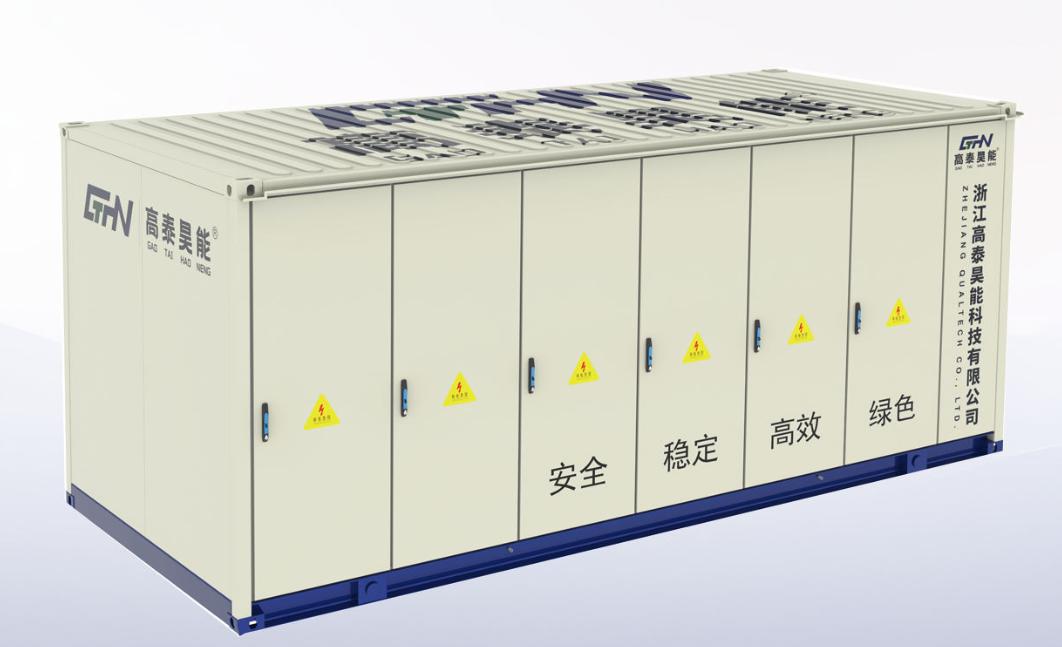
1. What Does a Battery Management System Do?
A battery management system is designed to monitor and manage the operating conditions of a battery pack or battery storage system. Its specific functions depend on the system architecture and application.
Battery Voltage and Temperature Monitoring
Battery cells do not always behave identically during charging and discharging. Differences in operating conditions and cell characteristics can affect the overall performance of a battery pack.
A BMS monitors individual cell or group voltages and temperature measurements through connected sensing units. When measurements exceed configured limits, the system can generate alarms or initiate protective actions according to its control strategy.
This information helps operators understand the condition of the battery system and respond to potential problems.
Battery Balancing and State Estimation
Battery balancing helps manage voltage differences between cells. Depending on the design, a BMS may use passive or active balancing methods.
The system can also estimate the state of charge (SOC), which indicates the remaining usable charge, and the state of health (SOH), which helps describe battery degradation over time. These values are estimates based on available measurements and models, rather than direct measurements of every aspect of battery condition.
For energy storage operators, reliable monitoring and estimation provide useful information for charging, discharging, maintenance, and operational planning.
2. Why Energy Storage Projects Need More Than Basic Battery Monitoring
A small battery pack and a utility-scale energy storage installation have very different system requirements.
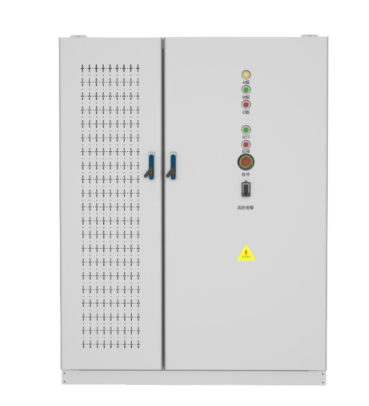
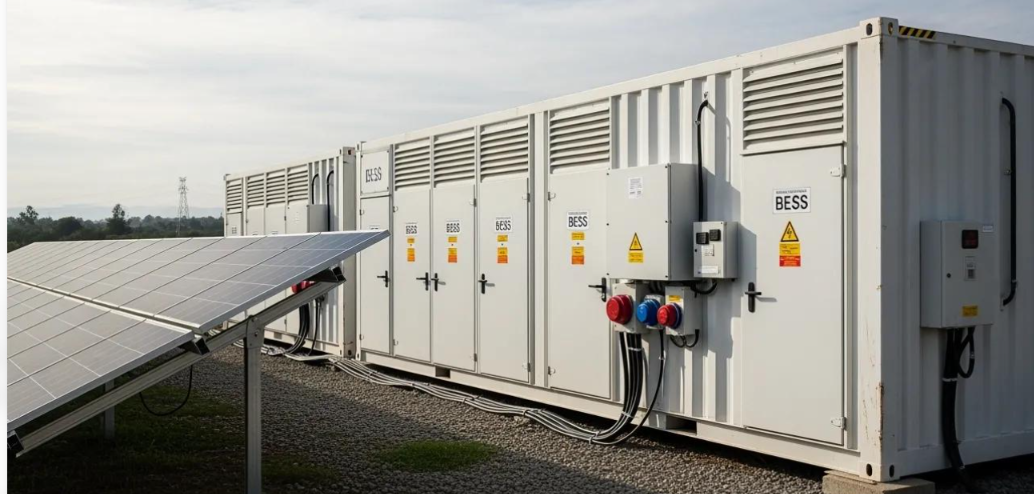
Large battery energy storage systems (BESS) may contain numerous battery packs, racks, electrical connections, control units, and communication interfaces. A problem in one component can affect system availability or require part of the installation to be taken offline.
This is why system integration matters.
A well-designed energy storage solution needs coordinated protection, thermal management, electrical control, and operational monitoring. It should also provide a clear way to identify alarms, review historical data, and determine which part of the system requires attention.
For project developers, the key question is not simply whether a supplier offers a BMS. It is whether the proposed control architecture can support the project's capacity, operating environment, communication requirements, and maintenance strategy.
3. How BMS, EMS, PCS, and Thermal Management Work Together
A complete energy storage installation relies on several systems performing different but connected functions.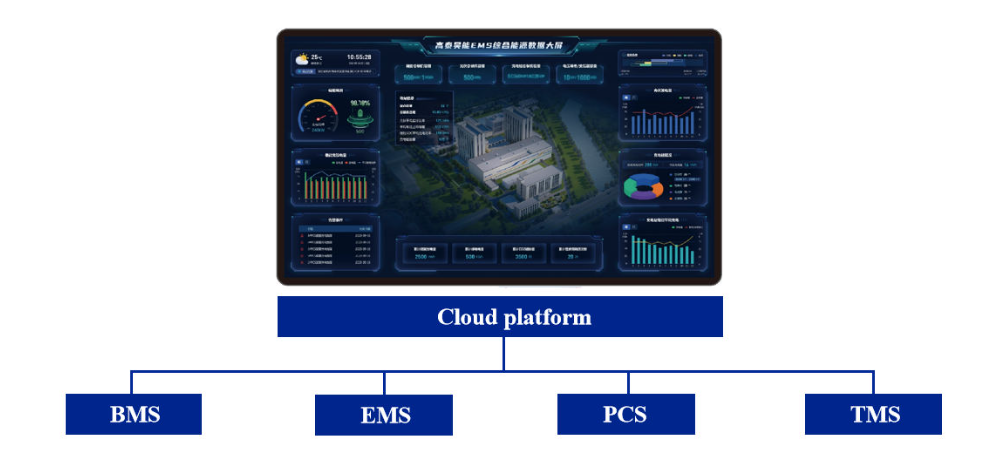
Battery Management System (BMS)
The BMS monitors battery operating conditions and manages battery-level protection functions. Its configuration determines which measurements, alarms, and control actions are available.
Energy Management System (EMS)
The EMS manages energy flows according to operating objectives, such as charging schedules, discharge requirements, and coordination with renewable generation or the electrical grid.
Power Conversion System (PCS)
The PCS converts electrical power between the battery's DC side and the AC electrical system. Its control functions support charging, discharging, and grid or load integration, depending on the system design.
Thermal Management System (TMS)
The TMS manages heat transfer and operating temperatures. Appropriate thermal management helps maintain suitable battery operating conditions and supports the overall safety strategy.
These systems need to exchange information and respond appropriately to operating commands and alarms. Their integration is particularly important in large installations, where independent equipment from multiple suppliers can create additional commissioning and troubleshooting work.
Zhejiang Qualtech Co., Ltd. identifies BMS, EMS, PCS, TMS, and cloud-based monitoring among its energy storage technology offerings. Its full-stack approach is intended to support coordinated system integration rather than treating every component as an isolated product.
4. Why Immersion Cooling Matters in Large Battery Storage
Thermal management is an important consideration in high-capacity battery storage projects. Battery cells generate heat during operation, and the amount of heat depends on factors such as current, operating conditions, cell design, and system configuration.
Immersion cooling is one approach to thermal management. In this design, battery cells are placed in a suitable dielectric cooling fluid, allowing heat to transfer from the cells to the surrounding fluid.
Qualtech's published 314Ah immersion-cooled container energy storage system uses lithium iron phosphate (LiFePO₄) cells and a submerged liquid-cooling design. According to the company's product specifications, the system has a nominal energy rating of 5,064 kWh and a specified depth of discharge of 90%.
These figures describe the listed product configuration. Actual usable energy and operating performance depend on system settings, environmental conditions, auxiliary consumption, and project requirements.
Immersion cooling should also be evaluated as part of a broader safety design. Cooling technology alone does not eliminate every battery hazard. Electrical protection, monitoring, fault isolation, fire protection, installation quality, and emergency procedures remain important.
For project developers, the practical goal is to assess how thermal management and battery controls work together under normal operation and abnormal conditions.
5. What Should Buyers Look for in a BMS Manufacturer?
Selecting a battery management system manufacturer requires more than comparing product prices or individual technical parameters.
Application experience: The supplier should understand the intended application, whether it involves stationary energy storage, electric vehicles, industrial equipment, or another battery-powered system.
Technical compatibility: Buyers should verify supported battery configurations, voltage ranges, sensing accuracy, communication protocols, and integration requirements before confirming a design.
Protection and testing: Ask how the supplier verifies voltage measurement, temperature sensing, communication functions, insulation performance, and protective responses. Relevant test records and certifications should be reviewed for the exact product model.
System integration capability: For larger BESS projects, compatibility between BMS, EMS, PCS, thermal management, and cloud monitoring can affect commissioning and ongoing operation.
Manufacturing and support: Production quality controls, traceability, documentation, spare parts, and technical support are important considerations for long-term projects.
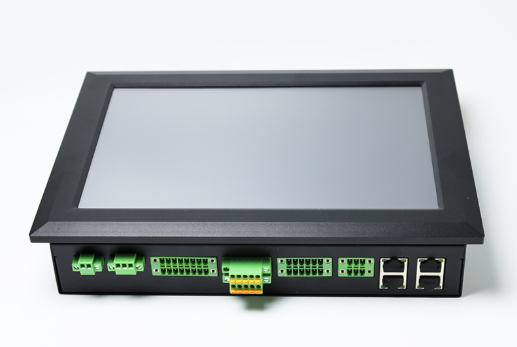
Established in 2011, Zhejiang Qualtech Co., Ltd. develops and manufactures battery management and energy storage control products. Its published portfolio includes battery management units, energy storage control equipment, and integrated storage solutions for different applications.
Buyers should evaluate the specific product documentation and project references relevant to their own technical requirements rather than relying on general company claims alone.
6. Building a More Reliable Energy Storage Solution
The reliability of a battery energy storage system depends on how its components are selected, integrated, operated, and maintained. A capable BMS provides essential battery monitoring and protection functions, but it works best when supported by suitable thermal management, power conversion, energy control, and system-level safety measures.
For commercial and industrial users, grid-connected projects, and other large-scale applications, the evaluation process should begin with clear operating requirements. These include the required energy capacity, power output, operating temperature, expected charging cycles, communication interfaces, and maintenance arrangements.
From there, buyers can compare system architectures and confirm whether the supplier can provide the necessary technical documentation and integration support.
Qualtech's combination of battery management products and energy storage system technologies provides a starting point for project-specific discussions. The appropriate configuration should be determined through technical evaluation, not by capacity figures alone.
Conclusion
A battery management system is a core part of modern battery energy storage, helping monitor operating conditions, manage battery protection, and provide information for system control. For larger installations, coordination between BMS, EMS, PCS, and thermal management is equally important.
When evaluating an energy storage solution, buyers should consider the complete system architecture, verified technical specifications, safety measures, and long-term support.
By matching these factors to actual project requirements, developers and equipment buyers can make more informed decisions about battery management technology and energy storage system integration.